
Anyone who is regular follower will have noticed that I went quiet for a six or so weeks. Sorry about that …
First it was a great holiday, then I have been head down in an urgent project to refresh most of the PC’s on the computer network at my business.
18 perfectly good working PC’s were rendered obsolete by Microsoft dropping support for Windows XP in April. Fair enough I guess: they have to draw the line somewhere. And of course, they have to keep the sales of Windows 7 and 8 moving along, don’t they?
The difficult process of upgrading just software didn’t make business sense for me, so it meant 18 “worthless old” PC’s off to recycling at best, or at worst, landfill.
Anyway, the project is done now and everyone is happy with their brand new, much faster Hewlett Packard desktop PCs that cost about $800 each.
Whilst repetitively waiting for software to load on each new machine I had time to ponder a few things about what I was doing …
Interesting, isn’t it, how the use of technology in offices has changed in a generation. The tasks now performed by about a dozen of the staff using these machines and software would have required at least half a dozen more staff 25 years ago. And the process flow would have been much slower.
Moreover, at $800 each, the cost of these machines was less than a week’s wages for the average of that dozen users in my business. When I first imported personal computers from Japan to Australia and sold them to accountants in the late ’70s, a typical package, with what would now be regarded as very primitive software, was $16,000 to $20,000. That was about the annual wages for a typical user!
Now, from a broad economic and business perspective, that’s a productivity gain.
Not such a great trend for office workers though. And that’s the issue that’s creeping up now on all our western economies, big time! Where are the new jobs coming from?
Next, and most obvious, was the short technology cycle that was seeing the old machines junked after just a few years use. I reckoned that what I was doing 18 times, was being done at very least 100 million times, with just desktop PCs, around the world in a year. (Industry authority IDC reckons there were 136 million desktop PCs shipped in 2013, a huge percentage of which would have replaced a PC already in place.)
100,000,000 is such a big number that it needs perspective. The world’s biggest container ship is a monster: 398 metres long and 58 metres wide. (The giant Queen Mary 2 that so dominates Sydney Harbour when she’s in, is a mere 345 metres long!) The new Madison Maersk, commissioned in 2013, can carry about 9000 standard 40 foot shipping containers (that’s the big, semi-trailer sized ones). You could stack maybe 2500 average old desktop PCs in one 40 foot container if you pushed hard. So, to ship away the well over 100 million junked machines, you would need to load the Madison to full capacity between 4 and 5 times! Quite a sight:

That’s a lots of steel, copper, gold, and plastic. Given the consumption of the planet’s precious metal and energy resources involved, I can only hope that a good portion of this junk is recycled. Our throw away economy really does need to reckon with hidden and unaccounted costs much more effectively.
And then this:
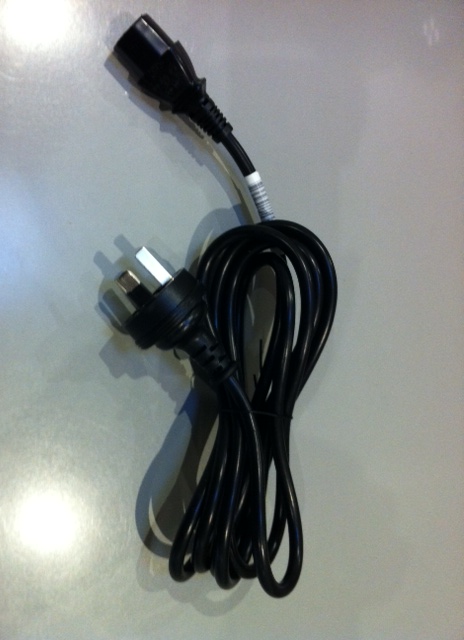
Yep … it’s a power cord.
It’s one of 18 power cords dutifully supplied with my new computers by Hewlett Packard. Hmmm … at first blush, I guess you’d expect them to supply one in each box …
… But hang on … these new machines were to replace old machines. When each was ready, I just took the new computer to the desk, unplugged the old computer leaving the old cord in place and plugged it in to the new computer. (Didn’t even bother crawling under the desk to turn the power off.) The old cord isn’t obsolete.
So now I have 18 brand new power cords in a box … destined for the tip, probably?
Above I speculated that my 18 computers are just some of 100,000,000 replacement machines in the world in a year.
So what does this mean? Well with a bit of rough maths, I calculate that these power cords, manufactured and supplied completely unnecessarily, would fill about one thousand 40 foot shipping containers, and, at say 50 cents a cord, represent maybe $50,000,000 worth of waste. I’ll leave it to someone else to work out how many barrels of oil went in to all that plastic, and how many tonnes of copper this represents.
Computer manufacturers are intent on maximising the efficiency of their supply chains. But I wonder at what cost to the precious resources of our planet?


 something 2 ponder
Very Interesting observation. Indeed, if we keep throwing away such large amounts of PCs, we are only preparing our own doom by destroying the environment.
Ian Kiernan started something special from a simple idea – yachting up Sydney Harbour and thinking to himself “we need to do something about all this rubbish”. Clean Up Australia, and all that. It makes me wonder if it is time for something similar here: the simple idea being that surely this insane waste of PC ancillaries could be limited if not stopped by raising awareness, and getting into the heads of to the decision makers?
to Peter’s comment… maybe it takes the humble consumer to be able to “opt out” or shipping me power cords, VGA cables. HDMI cables. etc etc… the power cord is just one of 3-4 default cables that is getting shipped per box
We recently went through a drawer at our place that has been happily collecting cables of various descriptions for years….computers, telephones, etc etc….and don’t get me started on TV aerial cables…I could open a stall at a market!