But I can’t afford it …

We’ve all said it.

“That would be great, but I can’t afford it.”

That house, that fancy car, that new dress, that exotic holiday, that night out …

BUT, in recent decades …

… The presence of credit cards in our wallets has made us much less careful in answering the question: “can I afford it?” But that’s the whole idea. We’ve been pumped along to consume: to buy stuff we don’t really need with money we don’t have. It keeps business in business. It makes banks rich. It keeps the economy moving. It keeps us relaxed and comfortable. It keeps politicians in power.

… And when it comes to bigger commitments like houses and cars, the sales people for banks (directly or indirectly) have always been ready with plenty of money to help satisfy our desire to acquire. It’s what they do: they sell money for profit. And, of course, they disguise the game by calling their salespeople relationship managers, customer service representatives, account managers, advisors … anything but a “salesperson” … and by convincing us they are offering objective “financial advice”.

So we all became less inclined/able to resist and say “… but I can’t afford it” … our modern culture even made it somewhat embarrassing to think/say that … after all, we must try to keep up! And we went into (too much) debt to do just that.

But, I sense that slowly people are starting to push back. Times aren’t what they used to be. Too much debt is too much. The big spending baby boomers are slowing down: they just don’t need to consume like they used to. Younger generations also, facing far more uncertain employment prospects, are, or are being forced to, resist.

This is clearly evident in the retail sector. In the US, big department store chains (Macys, JC Penney) are reporting poor results, closing stores and laying off staff. In Australia, the shopping season was hyped to the max, but the lack of crowing since about how good things are, says it all. David Jones and Myer are in poor shape. (I was surprised at Christmas to see how shabby David Jones in Sydney looked.) Retailers, big and small, are doing it tough.

There’s evidence in the housing sector too. Despite still very low interest rates, the big US banks are reporting much lower new mortgage activity since the uptick in rates a few months ago. In Australia, first home buyers are being squashed out of the market because they can’t afford to participate, despite record low mortgage payments.

Maybe now we are learning again to say … “but I can’t afford it”. And if we are, it’s going to have huge implications for business models, economic growth and financial markets.

And of course, as anyone who has even done a moment of sales job training knows, “but I can’t afford it” is the killer sales objection. If your prospective customer doesn’t have the money, its time to fold and move on to the next prospective customer.

So where are our Governments in this?

Massively in debt because they have suffered the same inability to say no. The same inability to say “… but we can’t afford it”

It’s OK, indeed up to cautious level, sensible, for Government to go into debt to fund long term projects and infrastructure. The debt repayments and interest are then taken from the revenue/benefits that accrue over the life of the infrastructure. We can safely call that good debt.

But Governments everywhere have been bamboozled by vested interests (particularly banks), and the ever present desire to buy votes, to take out the “credit card” and spend on recurrent services beyond the revenue (taxes) they collect. That creates recurring deficits and consequential Government (bad) debt.

Governments have behaved just like us really.

But perhaps now that many in the community are getting the idea that they “can’t afford it”, it’s time for Governments to do the same. They need to start saying to the all the vested interests, to the demanding voters: “good idea … but we can’t afford it”.

Politicians might even get a surprise how well the voters would receive a really well argued and communicated case for more tax or less spending. But are they smart enough, brave enough?

The Tea Party in the US is somewhere on this theme, but they have been making a complete hash of the politics. They are brave enough, but not smart enough. Extremism has rarely attracted a majority, and never delivered long term solutions to anything.

The massively indebted Europeans don’t seem to have a clue how to attack this issue. They don’t seem to be brave or smart. Although French President Hollande might just have attempted a first tiny step this week with a shift to acknowledgment that much current policy in France is unsustainable.

In Australia, Joe Hockey put his toe in this water just before Christmas. Will his political colleagues allow him to go further and act? Smart enough? Brave enough? Who knows?

Who was it said we get the Governments/politicians we deserve?

Sadly, I suspect we will just have to hit at least one more BIG financial and economic crisis before we can genuinely embark on the process of dissolving/dismantling the mountains of debt. The delusion and power of the Wall Street “masters of the universe” and their ilk will not be reversed by anything less.

Bring it on!

Posted in debt, politics and leadership, why do people do what they do | Tagged , , , , , , | Leave a comment

Beer goggles and holes

Is this the typical (central) bankers view of the mountain of debt in the world? … of the effect of the mountain of newly printed money? … of Wall Street reaching for the sky?

beer goggles


“Continuing large-scale asset purchases risks placing us in an untenable position, both from the standpoint of unreasonably inflating the stock, bond and other tradable asset markets and from the perspective of complicating the future conduct of monetary policy,” warns the admittedly-hawkish Dallas Fed head.

Fisher goes on “…QE [quantitative easing] puts beer goggles on investors by creating a line of sight where everything looks good …”

Fisher went on the remind his audience of the wisdom of the First Law of Holes espoused in the late ’70s by then-British Chancellor of the Exchequer Denis Healey:

“If you find yourself in a hole, stop digging.”

If you’ve got ten, read the whole speech … link above.

Posted in debt | Tagged , , , | Leave a comment

China’s debt

That China has pumped up it’s economic growth with a huge mountain of new debt is not in doubt. In 2008, the quick debt fueled economic stimulus was proportionately way bigger than any other economy in the world. But the Chinese have never really turned of the tap: debt continues to rise.

Much of it has been used to build amazing infrastructure: fast rail; motorways; power stations; dams; whole cities. Most of that is done by “local” Government, funded by state owned banks.

Much of this infrastructure has been built ahead of the need for it. But that’s not my focus today …

This from the New York Times:

The total debt of local governments in China has soared to nearly $3 trillion as the country’s addiction to credit-fueled growth has deepened in recent years, according to the findings of a long-awaited report released on Monday by the central auditing agency.

In the report, which is likely to further raise concerns about China’s debt problem, the National Audit Office found that local governments across the country had accumulated 17.89 trillion renminbi, or $2.95 trillion, worth of debt obligations as of the end of June. That was an increase of 12.7 percent [in just 6 months!] from December 2012, when local government debt stood at 15.88 trillion renminbi, the report said.

The June figure also represented a sharp increase of 67 percent from the end of 2010 …

The National Audit Office seems to have been pretty thorough. Get your head around this:

… the agency said, it deployed 54,000 auditors across the country, who combed through the books of more than 62,000 government departments and institutions and examined 3.4 million debt instruments related to more than 700,000 projects.

That’s one hellava lot of infrastructure!

The report led one analyst to opine:

Lu Ting, a China economist at Bank of America’s Merrill Lynch unit, estimated that China’s total public debt stood at 53 percent of gross domestic product. Adding corporate and household obligations lifts the total debt ratio to as much as 190 percent of G.D.P., he estimated. [I have seen other estimates as high as 240%]

China’s overall debt ratio “is neither exceptionally high nor low,” Mr. Lu wrote on Monday in a research note. [Who’s Kool-aid has he been drinking?] Still, he said he was concerned that for the last two years China has been adding debt faster than its economy has been growing.

“We believe the markets and the Chinese government should be alarmed by the rapidly rising leverage, but we do not believe China is on the brink of a debt crisis, [Really?] especially if the new leaders can take decisive measures to arrest its rising leverage,” Mr. Lu wrote.

Decisive measures? Like what? … there’s no soft way out of this …

Here’s what Fitch thinks …

China’s credit quality started to deteriorate in late 2011 as borrowers took on more debt to serve their obligations amid a slowing economy and weaker income. Interest owed by borrowers rose to an estimated 12.5 percent of China’s economy from 7 percent in 2008, Fitch Ratings estimated in September. By the end of 2017, it may climb to as much as 22 percent and “ultimately overwhelm borrowers.”

… and Goldman Sachs …

The nation might face credit losses of as much as $3 trillion as defaults ensue from the expansion of the past four years, particularly by non-bank lenders such as trusts, exceeding that seen prior to other credit crises, Goldman Sachs Group Inc. estimated in August.

And finally, for some perspective, consider this …

China bank assets


Do you reckon this might be a debt bubble? The description bank “assets” might be a bit suspect, don’t you think?

Posted in debt | Tagged , , | Leave a comment

Good debt, bad debt and unreal debt

Governments, corporations and people borrow to pay for something they need now, but don’t have enough cash/savings to pay for now.

If that something is a hard economic asset (say, a power station, or a house), part of the future income flowing from operating/using the asset (sales of electricity, rent) repays the loan and pays interest over the useful life of the asset.

Bankers borrow from those with surplus cash/savings, and make their money by lending carefully to borrowers (like those above) who can repay from the future cash flow generated over time by their underlying asset.

Quite simple, really.

A debt model like this is usually perfectly OK. Bankers have been making loans like this for centuries.

Now it’s all gone pear shaped because of greed. For a century or more, gradually at first, but now at an exponential rate, the fundamentals of the debt model above have broken.

Bankers were driven to try to make more for themselves by lending more.

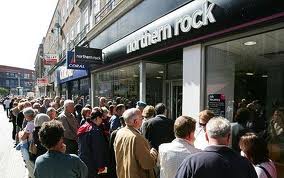
First, they figured they could lend out more money than they had: they could create money out of thin air! And so we have fractional reserve lending. This relies on the bet that depositors won’t want their money back faster than the borrowers were repaying. That works, until it doesn’t.

Down the years, it’s a bet by bankers that has gone very bad thousands of times. Yep, thousands. Here’s just one:

northern rock


Of course, they weren’t queuing to put money in … Ugly, eh.

In 2008 there were many banks faced with this predicament, but Governments stepped in with money and guarantees to avoid the otherwise inevitable calamity. Some we know about. Many more, I suspect, are still a secret. (We just don’t know how vulnerable even the biggest of the Australian banks was absent the Government’s guarantee.)

Second, bankers started risking the relaxation of the sensible lending principles above.

Bankers lent for consumption. Credit cards were handed out without a care. There was no asset, no future cash flow directly relating to the loan. This was just borrowing from the future, period.

Bankers lent for real assets borrowers wanted (rather than needed) like empty Chinese cities? And to borrowers who didn’t have any (rather than enough) cash/savings money and no income themselves (US sub prime).

Then the requirement for hard economic assets was by-passed. Future income was mortgaged: (Student loans in the US are $1+ trillion). Financial assets were leveraged: (Margin lending on Wall Street passed it’s all time high late last year).

All that is bad enough, but …

… then, when all else failed, greedy bankers made up weird “products” out of nothing, then lent against them. And then, just to be sure they didn’t lose money, bet against them. (This derivatives “market”/house of cards/casino is around $700 trillion!)

The 2014 financial market’s detachment from economic reality is truly breathtaking.

The bad debt is problem enough. Worse, is that all this unreal debt dwarfs the good debt, the banks equity, and the depositors’ funds. And if when, as happened in 2008, the music stops, the collapse will be spectacular.

Governments used all their dry powder in 2008. Next time will be different!

Posted in debt, financial markets, risk | Tagged , , , , | Leave a comment

Phantom recovery

Highlights from yesterday’s US Government press release on jobs:

  • unemployment down in one month from 7% to 6.7%;
  • 74,000 new jobs created in December.

Sounds OK doesn’t it? The economy must be recovering … (Wall Street rose a bit on the news.)

As usual the Government, the politicians and the popular media played to the optimism bias and painted as rosy a picture as possible. But it’s a complete delusion. Continue reading

Posted in employment, tough times | Tagged , , , , , , , , | Leave a comment

Politicians under pressure … democracy tested

Five or more years past the global financial crisis we are seeing more big trends that show just what a tipping point 2008 was.

In 2008 and 2009 many changes were obvious: falling stock markets; falling prices; wealth destruction; massive job losses; self interest trumping community and national interest; and even national interest trumping global interest, exemplified by the “failed” Copenhagen climate conference.

Now that we are 5 years on, wide-spread commentary has focused on the slower than ever before economic recovery everywhere, despite unprecedented stimulus and “experts” pulling on the economic levers. But it’s even worse because world economic growth is actually slowing, despite attempts by politicians tell us otherwise, and talk it up.

Permanently lower economic growth is starting to look like a new paradigm that our leaders don’t yet understand, or if they do, won’t be honest about. But is that such a bad thing? In my view it’s not. But our leaders don’t know how to handle it (and get them selves re-elected).

As one top Euro official Jean-Claude Juncker once confessed  “We all know what to do, we just don’t know how to get re-elected after we’ve done it.” His first phrase is disputable, the second, rare honesty.

One of the other flow on trends has been rising distrust of leaders, elites and institutions. Examples abound:

  • A tide of violent political protest. (Turkey, Ukraine, Thailand, Bangladesh are just a few of the recent examples.)
  • Protest about wages and employment conditions. (All over Europe, and recently even in the US.)
  • Unprecedented electoral defeats. (Exhibits 1 and 2: NSW and Queensland)

Distrust of politicians and traditional political parties is playing out just about everywhere.

Here’s an interesting graph today from the Economist showing the declared political affiliation of Americans:

US political parties


Just focus on the position in 2008, the year of Obama’s election. In the prior years Bush became less and less popular, so the relative positioning in 2008 is unsurprising: Republicans down and Democrats on a high; Independents about on long term average.

But look at the unprecedented trend since. Both Democrats and Republicans are significantly down. Independents way up, but no sign yet of a cohesive alternative third force.

If we could measure it, I’m guessing a similar pattern (of old parties and old thinking being out of favour) would emerge in most western democracies.

We also hear that the US Congress’ approval rating is 9%.

American politics as we knew it has clearly changed dramatically: in the near term definitely for the worse …

… But eventually? Maybe not.

What is certain is that the great American democracy is facing a stern test. The rest of us will just have to watch and hope it passes that test.

Posted in politics and leadership, power and democracy | Tagged , , , , | Leave a comment

The market v the economy in two graphs

The exuberance in the western world’s stock markets is palpable.

The lead is coming from Wall Street where the end of year celebration was lubricated by a 30% gain. Thanks to the Federal Reserve printing $1 trillion out of thin air for “bankers” and the market to feed on.

This has little to do with economic fundamentals. This one graph sums that all up nicely.

US economy and market

As you can see, 2013 was the year that the stock market (blue line) lost any attachment to the realities of the corporate profits (yellow sticks) that supposedly underlie share values. (That’s just to October: by the end of the year the blue line was reaching for the sky!)

But the real long term economic problem is the red line. Profits and the market have left the real economy way behind. Something has to break.

Another spin on a similar theme is a graph going around dubbed the death cross. You can do lots of things with graphs and numbers, but this certainly says something. Whilst forward expectations of economic growth steadily sank, the market took off. Since when did that make any logical, economic or market sense?

death cross

2014 looks like a good time to exit share investments before the high frequency traders’ algorithms do, don’t you think?


Posted in financial markets | Tagged , , , , | Leave a comment

Power and democracy … who rules?

Yesterday, whilst pondering “the entitlement to rule” attitude of those in power, I was reminded of a personal experience just about 13 years ago. For 20 minutes or more I sat next to James A Baker III on a bus. That’s right, on an ordinary bus. (Before 9/11: not a security man/spook in sight.)

You remember Baker. Chief of Staff to Ronald Reagan and George Bush Snr. One time Secretary of Treasury, and Secretary of State under Bush Snr. Lawyer. Primo Washington insider. Leader in the Texan and Republican elites.

I was an invitee at a weekend venture capital conference for the Carlyle Group in the Napa Valley, California. Baker was keynote speaker after the inevitable big splash dinner in an amazing underground cellar at one of the leading wineries several miles from the conference hotel. Buses ferried everyone to and fro.

Carlyle is huge. Very Washington connected. Baker and others are “patrons”. It is emblematic of everything about Washington; power; political connections; American capitalism.

The dinner was forgettable. Baker’s delivery was not.

Baker was fresh from his close participation in the “victory” in the US Supreme Court in Bush v Gore, that greatest of sliding door moments, delivering George W Bush to the presidency. In front of an audience heavily sympathetic to Bush, Republicans, power, capital, and American exceptionalism, Baker felt free to let go. In an underground echo chamber he boomed from the pulpit.

First, a lengthy justification of the “correctness” of the election result. On his take, America had just been rescued (by one man as it happens – Justice Anthony Kennedy) from the jaws of a fate worse than anything the audience could imagine. We should be celebrating because America was now back in the safe hands of those who knew how to govern.

Predictable? US politics? Of course, he would say that, wouldn’t he … but then …

… Baker proceeded to boom out his outline (with ex Secretary of State hat on) of what the foreign policy imperatives were for the new Bush Administration. China and Europe got a mention (Australia didn’t), but the dominant focus was Iraq, the Middle East and energy security. Not only were the new Republicans in charge in the US, the rest of the world was about to be told what to do, all under the guise of “protecting the security of America”. The arrogance of power was breathtaking.

So now back to the bus …

After the event, everyone straggled on. As I walked down the aisle, all seats were full, except one half way back … next to Baker. Had everyone else had avoided him?

“Hi, mind if I sit here?” … “Go ahead”

“I’m Geoff” … and some other pleasantries …

“Are you from England?” … “No, Australia” … “Oh, great country. I’ve been there.” … and more pleasantries.

We then discussed his comments on the recent election, and somehow we got to an exchange that went something like this …

“You have compulsory voting don’t you?” … “Yes we do”

“Doesn’t that mean you end up with more left wing Government?” … “I don’t know. Not right now it doesn’t. Current Prime Minister Howard is quite conservative, right wing.”

“But it does mean you have a lot more uneducated and working class people voting, doesn’t it?” … “That’s possible, but often they are nervous of change, conservative. Paul Keating reckoned that “conservative” vote won him the 1993 election.”

“I never met Keating. Was he left wing?” … “He succeeded Bob Hawke as Labor prime Minister” … “Ohh, Hawke. I knew him. He was a good guy.” (I’m sure Bob would be pleased to know Baker remembered him … sort of.)

… and then this …

“Well in the US that ignorant class wouldn’t vote for us. We can’t afford to let them have a vote.”

I was dumbfounded. I sat looking straight ahead wondering what to think, what to say.

Sensing my reaction, Baker then said … “that sounded pretty arrogant, I guess’ …

“Yeah”

Mercifully soon we arrived back at the conference hotel and got off the bus.

So there you have it … modern “democratic” politics in one word …

Power.

Whatever it takes … to grab it, and then hang on.

Posted in power and democracy | Tagged , , | 1 Comment

Good bye 2013 …

Was 2013 a good year for you, one to celebrate? … or are you glad to see the back of it, and pleased to celebrate the arrival of 2014?

Either way, there was one helluva celebration a couple of nights ago. What do you reckon: around the world, maybe $100 million, maybe $200 million, maybe more, blown up in fireworks alone. A martian would be excused for thinking things are going really well. And that is also, of course, what our political leaders want us to think. Continue reading

Posted in inequality | Tagged , , , | 1 Comment

Hockey’s challenge

107 days have already gone for the new Australian Government. It will be another 140+ before we see it’s first full budget. Nearly a quarter of their elected term will be gone! 18 months after that, they will be right back in electioneering mode. And, we all know what that likely means: no new taxes; new handouts for the punters; “vote for me” promises and policy settings aimed at the swinging middle Australian voters’ hip pockets. Continue reading

Posted in politics and leadership, tough times | Tagged , , , , | Leave a comment