Time for a banker to go to gaol?

BNP Paribas, France’s biggest bank, is in trouble with the law in the US. It is apparently guilty of violating US financial sanctions against Iran and others. The US Department of Justice (DOJ) suggested the bank plead guilty and pay a $16 billion fine. The bank offered $1 billion. Negotiations continue. $10 billion is the rumoured outcome. Reuters had the story on 12th June:

The chief operating officer of BNP Paribas is to step down at the end of June and retire completely on Sept. 30, France’s biggest bank announced on Thursday as talks with U.S. authorities over a potential $10 billion fine gathered pace.

New York’s banking regulator had requested the departure of the long-serving [42 years] Georges Chodron de Courcel as part of a settlement for alleged violations of sanctions against Iran, Sudan and other countries, a person familiar with the matter told Reuters on June 5.

U.S. authorities … are investigating whether BNP evaded U.S. sanctions between 2002 and 2009. Sources familiar with the matter say they are trying to establish whether the bank stripped out identifying information from wire transfers so they could pass through the U.S. financial system without raising red flags.

Does that sound like fraud to you? … It does to me … So why is Georges just being invited to “step down”? … Surely if he’s been responsible for that level of naughtiness in the bank, he should go to gaol … mere mortals like us would be there for causing very much less damage to our fellow man.

It’s way beyond time some big time banker went to gaol. Fines imposed, effectively on the shareholders of banks, don’t seem to be a deterrent. Maybe a few years on Rikers Island would make them think a bit more about what they do.

Next day it was Citi. They’ve been up to no good in selling mortgage bonds. The DOJ is not satisfied with Citi’s offer to pay $4 billion: they are apparently planning to take Citi to Court to get $10 billion.

These are gigantic fines. For context, the total profit of all 4 of Australia’s big banks combined in 2013 was about US$26 billion. Woolworths total annual revenue from all activities (supermarkets, pubs and liquor, hardware, BigW, property) is about US$60 billion.

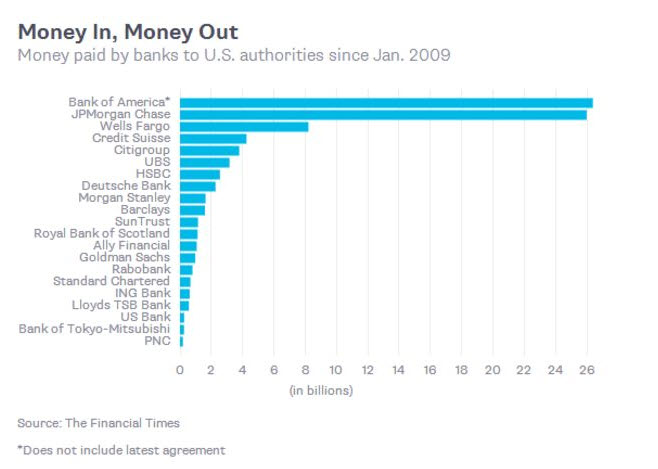
Earlier in the month this appeared in the London Financial Times:

bank finesThis adds up to about US$87.5 billion.

It does not include the two matters mentioned above, and many others that are no doubt still in progress.

Given that the Regulators are widely regarded as toothless and timid, yet they have imposed these fines, we can only wonder at the actual scale of the criminal activity in banking.

And how many senior, responsible executive bankers from these 21 financial institutions have gone to gaol for the crimes that have brought forth these fines?

None.


Posted in financial markets, inequality | Tagged , , , | Leave a comment

Could this be the market’s trigger?

Stock markets around the world have been defying gravity for months and months now. Rising ever higher in the face of logic, real economic performance and common sense. It’s now a precarious gamble: hang on and hope that a greater fool will buy you out just before the music stops.

When the music stops, buyers disappear and prices plummet.

The big question is: what will be the trigger that causes the music to stop?

Ukraine looked a likely trigger … but it seems not.

A property price crash in China could still be a trigger. China’s property market is an accident waiting to happen.

The Syrian civil war? The stunning election results for the European Parliament? Negative interest rates in Europe?

No, no, and no.

Then this week a new possibility from the ever turbulent Middle East. The extraordinary events in Northern Iraq.

ISIS is not an ordinary terrorist group. They already control much of the western desert in Iraq. They have been the most “effective” opposition fighters in Syria and control part of the north of that country. They have thousands of well organised and well trained fighters. They have a sort of uniform, and a flag. And, it appears they have strong leadership and a clear (and achievable?) mission to create an Islamist State across the north of Syria and Iraq.

This week they have conducted a lightning strike and taken control of Mosel, Iraq’s second biggest city of 2 million. Reports are saying:

  • Iraqi police and military personnel have taken fright and run away.
  • 500,000 people have fled Mosel … (goodness knows where to?)
  • ISIS has looted the Mosel Central Bank and made off with $US429 million.
  • Other banks have been looted for cash and gold.
  • A thousand or more prisoners have been let loose.
  • ISIS has seized military hardware, including possibly Blackhawk helicopters.
  • They have then moved on south to Baiji: the site of Iraq’s biggest oil refinery and a key source of energy to Baghdad.
  • and so on …

The US State Department is “deeply concerned” …

… and well they might be. This could turn very ugly very quickly.

Would the markets notice a full scale civil war in Iraq? … let’s see …

Posted in financial markets, risk | Tagged , | 1 Comment

A humble power cord hits the tip?

Anyone who is regular follower will have noticed that I went quiet for a six or so weeks. Sorry about that …

First it was a great holiday, then I have been head down in an urgent project to refresh most of the PC’s on the computer network at my business.

18 perfectly good working PC’s were rendered obsolete by Microsoft dropping support for Windows XP in April.  Fair enough I guess: they have to draw the line somewhere.  And of course, they have to keep the sales of Windows 7 and 8 moving along, don’t they?

The difficult process of upgrading just software didn’t make business sense for me, so it meant 18 “worthless old” PC’s off to recycling at best, or at worst, landfill.

Anyway, the project is done now and everyone is happy with their brand new, much faster Hewlett Packard desktop PCs that cost about $800 each.

Whilst repetitively waiting for software to load on each new machine I had time to ponder a few things about what I was doing …

Interesting, isn’t it, how the use of technology in offices has changed in a generation.  The tasks now performed by about a dozen of the staff using these machines and software would have required at least half a dozen more staff 25 years ago.  And the process flow would have been much slower.

Moreover, at $800 each, the cost of these machines was less than a week’s wages for the average of that dozen users in my business.  When I first imported personal computers from Japan to Australia and sold them to accountants in the late ’70s, a typical package, with what would now be regarded as very primitive software, was $16,000 to $20,000. That was about the annual wages for a typical user!

Now, from a broad economic and business perspective, that’s a productivity gain.

Not such a great trend for office workers though.  And that’s the issue that’s creeping up now on all our western economies, big time!  Where are the new jobs coming from?

Next, and most obvious, was the short technology cycle that was seeing the old machines junked after just a few years use.  I reckoned that what I was doing 18 times, was being done at very least 100 million times, with just desktop PCs, around the world in a year. (Industry authority IDC reckons there were 136 million desktop PCs shipped in 2013, a huge percentage of which would have replaced a PC already in place.)

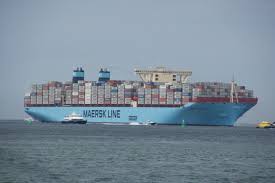
100,000,000 is such a big number that it needs perspective.  The world’s biggest container ship is a monster: 398 metres long and 58 metres wide.  (The giant Queen Mary 2 that so dominates Sydney Harbour when she’s in, is a mere 345 metres long!)  The new Madison Maersk, commissioned in 2013, can carry about 9000 standard 40 foot shipping containers (that’s the big, semi-trailer sized ones).  You could stack maybe 2500 average old desktop PCs in one 40 foot container if you pushed hard.  So, to ship away the well over 100 million junked machines, you would need to load the Madison to full capacity between 4 and 5 times! Quite a sight:

madison

That’s a lots of steel, copper, gold, and plastic.  Given the consumption of the planet’s precious metal and energy resources involved, I can only hope that a good portion of this junk is recycled.  Our throw away economy really does need to reckon with hidden and unaccounted costs much more effectively.

And then this:

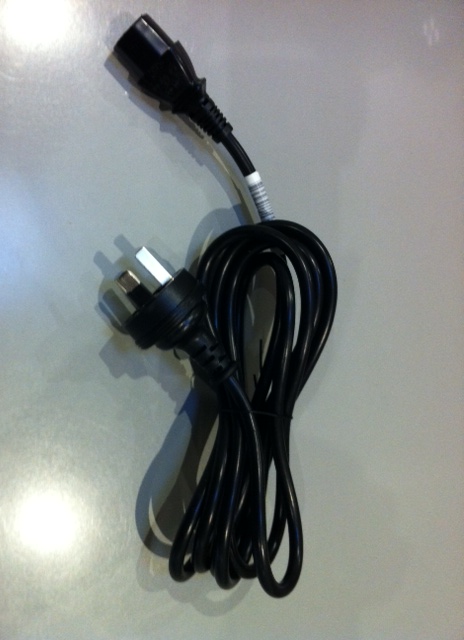
power cord

Yep … it’s a power cord.

It’s one of 18 power cords dutifully supplied with my new computers by Hewlett Packard. Hmmm … at first blush, I guess you’d expect them to supply one in each box …

… But hang on … these new machines were to replace old machines.  When each was ready, I just took the new computer to the desk, unplugged the old computer leaving the old cord in place and plugged it in to the new computer.  (Didn’t even bother crawling under the desk to turn the power off.)  The old cord isn’t obsolete.

So now I have 18 brand new power cords in a box … destined for the tip, probably?

Above I speculated that my 18 computers are just some of 100,000,000 replacement machines in the world in a year.

So what does this mean? Well with a bit of rough maths, I calculate that these power cords, manufactured and supplied completely unnecessarily, would fill about one thousand 40 foot shipping containers, and, at say 50 cents a cord, represent maybe $50,000,000 worth of waste. I’ll leave it to someone else to work out how many barrels of oil went in to all that plastic, and how many tonnes of copper this represents.

Computer manufacturers are intent on maximising the efficiency of their supply chains. But I wonder at what cost to the precious resources of our planet?


Posted in technology, why do people do what they do | Tagged , , , , | 4 Comments

Where’s Malcolm?

I share with probably a majority of voters the opinion that Malcolm Turnbull would do a better job of leading Australia than any other realistic candidate.

I don’t agree with everything Malcolm says or does, but then who would?  Right now he is constrained by “cabinet solidarity”.  That farcical party political convention that forces him to say and do things that his body language and his choices of expression says he doesn’t really believe.  Freed of that constraint, I suspect that we would all find Malcolm an even more positive force for the good of Australia.

When we were going through that nonsense after the August 2010 election of piecing together a new Government I emailed Malcolm thus:

Message To Malcolm: I reckon the 100+ year old Constitution, the 100 year old Labor Party and the 60 year old Liberal Party are ALL past their use by date.  In the current situation YOU have a golden opportunity to lead Australia towards a genuine new 21st century political and government paradigm (maybe a republic?).  Why not go to the cross benches, get a dozen or more of the smartest MPs to follow (hardly a challenge I would have thought).  Then demand that you be PM leading a real Government! … What’s your alternative? … 3 years in the opposition? …. What a waste …. SEIZE THE MOMENT … regards … Geoff O’Reilly

Somewhat to my surprise, I found myself put on Malcolm’s social media database, and received the following reply on 1st September 2010:

Dear Geoff,

Thank you for writing – I appreciate your support.  However I am committed to the Coalition, and look forward to being a part of a new Coalition Government.

Best wishes, Malcolm

I guess at that time Malcolm was fondly hoping there would in fact be a new Coalition Government.  But it was not to be.  On the 7th September Windsor and Oakshott chose to support Labor.  So I rather cheekily sent Malcolm this:

Well then … you blew that opportunity, didn’t you … where to now? … get out of the 9 dots box … why not ask Julia for a cabinet position and make a serious contribution to the nation’s good government, maybe?

This time he didn’t respond … or take my advice!  What a pity …

In opposition, Malcolm patiently turned the then Liberal policy to completely dismantle the NBN into a policy that meant we would at least have an NBN backbone, and he cunningly left the door wide open for it to be turned into the real thing over time.  The NBN is a vital piece of infrastructure for Australia’s long term future.  Malcolm knows that.  He also knows that taking Abbott full on, head on over the NBN would get him nowhere.  So he’s outsmarted Abbott and we have the NBN policy we have.  Good politics!

Now in Government he seems to be very quietly and successfully getting on with the job of giving us the “NBN we can have” – for now.  Tomorrow is another day, and no options are off the table.

Then, in all the furore pre- and post- the Budget, Malcolm has kept a very low public profile, notwithstanding his eminent qualifications to be an important and highly credible messenger to the Australian public of what we really need to be focused on for our own good.  Instead we have had to listen to the blatherings of ministers like Pyne, Dutton, Cormann, Abetz and Andrews as support acts to Abbott and Hockey.

Why?

I reckon there will be two reasons:

    • Malcolm is just too good, too popular and too credible for Abbott to let him loose. That would be bad for Abbott.  In support of this idea, look at this SMH poll that closed just three days ago with almost 47,000 responses:
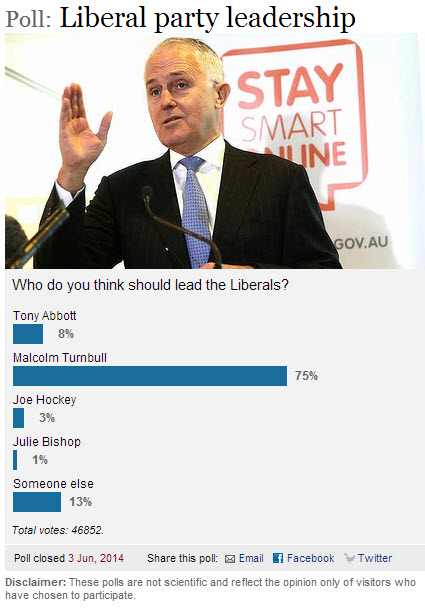
leadership poll

    •  Malcolm struggles with the Abbott philosophy.  (Of course, he would, in the name of  government solidarity, deny that.  Just as, in the last few days, he has repeatedly “supported the government” and told us how united it is.)  Hmmmm …

Let’s follow this second idea for a minute and see what we might get as a “set free” Turnbull philosophy.

First, the squawking extreme right commentariat (Bolt, Jones, the Australian and others) would struggle for a look in.  Politicians like Brandis, Bernardi and others like them would be ever so politely be ignored.  And, where necessary all of the forgoing would be taken on with calm reasoned debate about ideas, not retaliatory squawking.  Just look for evidence at the events of this week over the “Palmer dinnergate”, and Malcolm’s willingness and ability to get stuck in to Bolt and Jones afterwards.

Second, the recent budget attack on those less fortunate and less able to look after themselves would be reversed.  This week I had an email from Malcolm (along with thousands of others I guess).  It started thus:

“Geoff, I’ll be Sleeping Out for St Vinnies

The mark of a great society is the way it treats the neediest and most vulnerable …”

So how do you think Malcolm really thinks about the Abbott philosophy embedded in the Budget?

Third, I think Malcolm would espouse a conservative fiscal approach.  He would certainly cut into unnecessary expenditure and welfare (and there’s plenty of that), but it would be accompanied by a preparedness to take on the debates about where the money has to come from (genuine tax reform would be front and centre of the agenda).  Wise men like Ken Henry would be listened to.  He would create understanding that some debt, for financing long term assets of the nation, is smart: but debt to fund recurrent expenditure is not sustainable.  And so on.

Fourth, Malcolm’s clear discomfort with our current immigration/asylum seeker policies would see us adopt a manifestly more humane policy, rather than the misguided populist stance we now have.

Fifth, he would make a peerless ambassador to the world.  No more embarrassing nonsense: (like that recently with Indonesia).  We would expect (and get) smart navigation of the delicacies of things like the relationships with China and Japan: both so critical to our economy and trade, but currently squabbling over rocks (and oil reserves?) in the South China Sea.  We would no longer be the unquestioning Deputy Sheriff for the US in Asia.

We would price carbon and respect the environment.  Malcolm’s credentials and beliefs in this regard are long standing and unquestioned.

We would get a good NBN soon … and a better one later.

He would advocate a vision, for the long term, for sustainability, for fairness …

But I wax on …

You get the idea.  Why doesn’t Malcolm be Malcolm in the Middle.  Toss away the loony right wing neo-con zealots.  Avoid being beholden to the far left, to Unions … to any pressure groups for that matter.

Lets make a fresh start.  Stand up and lead the middle, Malcolm.  You might be surprised how many smart people (from both side of the current political fence) would follow.

 

Posted in politics and leadership, why do people do what they do | Tagged , , , , , , | Leave a comment

Careful what you wish/vote for …

What did you think of the Federal Budget?

It has certainly created more talk, and for a much longer time, than is usual.  It has elicited some excellent commentary on the ABC website and in the Sydney Morning Herald from quality thinkers like Waleed Aly, Tim Dunlop, Ross Gittins, and Jonathon Green.  Here is some flavour, and links to the articles, if you have the time and interest in any of them.

“Hockey wants us to believe he had no choice but to do what he did. I accept he had to get on with bringing the two sides of his budget back into balance, but he had a lot of choice in the measures he took to bring that about.

He chose to focus on cutting three big classes of government spending: health, education, and income-support programs (pensions, the dole and family tax benefits). Not by chance, these are the programs of least importance to high income-earners.” — Ross Gittins SMH

“Politicians can obviously survive broken promises, but Abbott’s first budget has taken us into new territory.” — Tim Dunlop ABC

“… with this budget, the government was behaving as though it had the most monstrous of mandates. It was positively radical in its ambition to break the social democratic model of our welfare state.” — Waleed Aly SMH

“… if this Budget marks anything, it is another decisive step in the distancing of the political class from the interests of the public it nominally serves …” — Jonathon Green ABC

Commentators like these make a lot more sense than the politicians, don’t they?  I have no doubt the Murdoch press and talk-balk radio hosts had a different perspective, but I haven’t time to dwell on their partisan clap-trap.

Even the incomparable Annabel Crabb is wondering where the “adult” government has gone?

“… the promise of ‘grown-up government’ was an especially reverberant one. … But the first post-budget parliamentary sitting week … is starting to look distinctly like a fraternity cracker night.” — Annabel Crabb ABC

The fact that a wider community has paid attention and is talking about all aspects of the Budget is a good thing.  We certainly need to be stirred from our relaxation and comfort. We need to realise that a continuation of the trends established through 23 years of continuous economic growth, much of it fueled by an ever increasing mountain of household debt, is impossible.  2008 changed everything.  And a further (perhaps even bigger) economic/financial correction is likely coming quite soon.

Joe’s messages about the sustainability of welfare, health and education services without “something being done” are on the mark.  Current settings and trends for these government expenditures are not forever sustainable under our current tax regime.  We have to make careful new choices about the levels of tax, expenditure, standards of living, and so on.

But the idea that the government debt and deficit is currently “out of control” is gross political exaggeration.  Scaring the voters to enlist support for harsh policy is as old a trick as politics itself.

Scare campaign or not, my sense is that this simple message is starting to sink in. People are reacting to the idea that government largesse will shrink and taxes must rise. Even then our standard of living (measured in financial terms) will likely fall over the next decade or two.

We’ve seen the news items about bulk billing doctors saying that the flow of patients has decreased (even though $7 levy is still far from a fact).  Consumer confidence was measured to plunge, (but has now recovered a bit).  A coffee shop waitress, a hairdresser, a taxi driver, a garden shop owner, and a manager of pubs have all told me things have been “quiet this last few weeks”. So look for further news about flat consumer confidence, and retailers complaining in the next month or so.

But more saving and more debt reduction, and less unnecessary consumption won’t do us any harm.  Of course the banks won’t like it because their job is to sell more debt: that’s what makes them rich.

So far so good.  But then there’s the issue of where the burden falls.

Much of the talk has been about the inequity of the impacts of the budget. The privileged, asset owning generation came through pretty unscathed.  Not so the young unemployed, young families, students, the sick, the disabled and pensioners.

Sure, there are areas where our welfare system and government expenditure could do with some discipline and reform, but not whilst the exorbitant privileges enjoyed by: house owners (negative gearing, capital gains tax exemptions); banks and investors (tax free financial transactions); superannuation funds discretionary contributors (big tax concessions); corporations and trusts (tax lurks and avoidance) are left totally unaddressed.

And this flows on to the politics.

We certainly now have a much clearer divide in political philosophy.  Gone, it seems, are the days of the drift of both the left and the right of politics to the centre.  Gone are the days when commentators could lament that the two main parties were so alike there was no real choice.  Abbott and his government have, with this budget, clearly set their course hard to the right: “lower taxes, lower expenditure, fend for yourself”.

Next time we vote it looks like it will be much less about this or that silly promise or sound-bite, and much more about what fundamental political philosophy we like, and what sort of society we want.

On that note I should leave the last word to that wonderful long time student of Australian society, Hugh Mackay.  At the end of a powerful essay here in the SMH Hugh concludes:

“… this is a profoundly disappointing budget. It’s not the economics; it’s not the politics; it’s the clear sign that this government has young people, the sick, the poor, the unemployed, the elderly and the marginalised in its sights.

It’s a budget that not only turns its back on the problem of inequality; it exacerbates it.”

Posted in inequality, politics and leadership | Tagged , , , , , | 1 Comment

Co-incidence or consequence?

Michael Lewis seems to be getting more mentions than anyone in the financial press and blogs this week. He’s clearly hit a raw nerve with his new book “Flash Boys”.

Here are just a few of the things that have happened since the book was released just two weeks ago at the end of March …

FIRST … The Securities and Exchange Commission (SEC) the financial regulator of Wall Street, the Federal Department of Justice, and the FBI have all announced they have opened separate investigations into High Frequency Trading (HFT) …

Co-incidence or consequence?

SECOND … A lawyer in Chicago has sought leave from the Courts to open a class action against the Chicago Mercantile Exchange (CME) and the Chicago Board of Trade (CBOT). (The CME is the world’s biggest centre for trade in market futures, and one of the major players around HFT.) The allegation is that the CME …

… not only permitted the HFTs to see price and market data, including open orders, market orders before all other market participants and traders saw the price and market data, they permitted the HFTs to execute trades using this same non public data and order information before all other traders and market participants. In so doing, the [CME and CBOT] engaged  in a fraud on the marketplace, deceptive practice and failed to maintain a marketplace that is free from market disruption and market manipulation …

Of course the CME has denied they’ve done anything illegal – and they may be proved correct about that by a ponderous and expensive legal process. But the real issue here is: if it is legal (as commentators seem to think), does being legal mean being right? Certainly not, in my view.

Co-incidence or consequence?

THIRD … On 2nd April the S&P 500 broad share index hit it’s all time high of 1897, but in less than 2 weeks since it has dropped to close last week at 1816. That’s a drop of 4.2%: pretty significant really. Have we just seen the top?

Co-incidence or consequence?

FOURTH … Goldman Sachs, a key first major supporter of the IEX exchange set up by the Flash Boys is doing it’s best to look like the good guy. They are quickly winding down their presence in the HFT environment. They are reported also to be winding down their dark pool called Sigma X, one of the biggest of the 45 dark pools operating in secret on the edges of the regulated public markets.

No co-incidence here!

FIFTH … According to the New York Post, the SEC has announced it is considering new regulations of HFT and dark pools, and is already moving to shut down some of the more sinister operators …

The Securities and Exchange Commission is preparing to remove some high-frequency trading firms.

In a purge of computerized markets, prompted by public outrage unleashed by Michael Lewis’ “Flash Boys,” the SEC’s campaign will see numerous enforcement actions, new rules and new business practices — a sweeping overhaul that could benefit the beleaguered New York Stock Exchange, The Post has learned.

Looks like a consequence here!

And SIXTH … lo and behold, the SM Herald is on the case today. They report Australian researchers have “discovered” that market manipulation is rife in the Australian share market. In this case they find that traders have been artificially pushing up the market just at the times that their performance is measured for getting their monthly, quarterly and annual bonus.

Well fancy that!

Give a trader a ridiculous financial incentive to make money for himself and you can guarantee that he’ll do everything (push, pull, collude, whatever it takes) to maximise his bonus. It’s called greed. Not much of a “discovery” really …

And probably not a co-incidence that the research comes to the surface just now.

It’s clearly way past time to call time on the financial “industry” …

Posted in financial markets | Tagged , , , , | Leave a comment

Is the stock market rigged?

Michael Lewis thinks so.

On 30th March he went on CBS’ 60 Minutes in the US to promote his latest book “Flash Boys” an expose of the the dark world of High Frequency Trading (HFT). There he asserted “the US stock market is rigged”.

I read “Flash Boys” last week. Like other books by Lewis (Moneyball, The Big Short, Boomerang, among others) it’s a great read. Well researched, entertainingly presented. He has a great knack of weaving an engrossing story around serious money subjects. Anyone who owns and trades shares should get a copy.

HFT is the process whereby traders (frequently the big Wall Street “banks”) use their ultra high speed computer systems and close, highly optimised fibre optic network connections to multiple stock exchanges to skim a cent per share here and cent per share there between the genuine sellers and the genuine buyers. Doesn’t sound like much, but done billions of times HFT accumulates billions of risk free dollars into the hands of unscrupulous middlemen.

Some time ago Morgan Stanley reckoned 78% of all trades were HFT trades.

On another dimension, these same middlemen are now diverting a large proportion of trades (40% is suspected) into their own so called “dark pools”. Dark pools are almost totally unregulated and hidden “exchanges” privately run by banks or brokers to execute trades amongst their owns clients. Away from public exchanges (and exchange fees of course) there is no guarantee the price of the trade is the proper market price.

So there you have it. Markets set up by middlemen entirely for the benefit of the middlemen.

Just like a gambling casino really!

And, the regulators have about as much chance of catching up by their conventional processes as authorities have of eliminating Mexican drug cartels. Under pressure this week from the spray of publicity created by Michael Lewis’ book, one Commissioner of the SEC (the US regulator) admitted that hitherto their regulations had been created for people, not for computers.

Oooops … time to catch up, don’t you think?

Flash Boys is the story of a small group who worked hard and long, but finally figured out what was going on and have set up yet another new stock exchange (IEX) to try to break these now embedded unscrupulous practices. We should wish them well.

So what’s the answer to Wall Street greed?

Rather than thousands of impenetrable pages of regulations that well paid lawyers will always find ways past, the solution, I think, is simple.

If you want to be a licenced, Government supported, deposit taking bank, then you can only lend out against deposits taken within historically tried and tested limits and ratios. Nothing more. A boring predictable old style business, but an essential one in a modern economy. You must not indulge in any other business activity.

If you want to be a stock broker, then you must bring all trades to a regulated public market/exchange and settle the trade between arm’s length buyers and sellers. If, as a broker, you want to own shares, you can, but when you sell any such shares you pay an immediate tax on the sale proceeds, perhaps at a declining rate the longer the shares are owned.

If you want to import something, you go to a licenced bank and buy just the amount of foreign currency you need to facilitate the import, no more. (Exporters would sell their foreign currency proceeds to the same banks.) There is no need for foreign currency trading to be equivalent to many multiples of real trade. (In the case of the $A, roughly 50 times!)

Then we have genuine economic risks too great to bear alone: factory burns down, crop fails, etc. You can take it to an insurer, who will collect a fee (premium) and share that economic risk with you. But insurers who want any sort of express or implied support beyond their own balance sheet (AIG bail-out), must be prohibited from taking risk on the value of any purely financial instrument.

That should pretty much cover the legitimate, economically essential capital and risk management markets, necessary to bring together genuine borrowers and lenders, genuine savers and investors, and the risk averse with risk takers.

That leaves the other, totally unnecessary stuff: speculation, derivatives, futures, shorts, wild ideas, the “casino”.

For those that want to gamble in the financial casino, let them. No playing with other peoples money though. If they can win, good luck to them, if they lose, tough.

Then, from a Government and society perspective treat this part of the financial “industry” as we do a casino … Corral it, and tax it.

Governments everywhere need more tax revenue: for them, this approach solves two problems at once.


Posted in financial markets, risk | Tagged , , , , | Leave a comment

Science is even more certain about climate change

A couple of weeks ago the IPCC released its fifth major report AR5. 32 volumes is a bit much to wade through for most, but the Summary for Policymakers is a very digestible 28 pages (pdf) expressed in such plain language that even our politicians should be able to understand it. And for those especially in need of even simpler, quick conclusions, the IPCC has helpfully highlighted the main conclusions in 19 (brown?) pullout boxes of less than half a dozen lines each.

Within the limits of scientific certainty, the IPCC’s conclusions are unequivocal. The climate is changing, temperatures are rising, snow and ice is receding, sea levels are rising, etc, and humans are the cause. Continue reading

Posted in climate change, politics and leadership, risk | Tagged , , | Leave a comment

China’s corporate delusion

In Hong Kong last week I picked up a copy of the Asian Wall Street Journal and came across a story of complete delusion in the State owned corporate sector.

Apparently state owned Zoomlion makes construction equipment, half of it “concrete equipment”. In 2013 sales fell 20%. That isn’t great, but it’s hardly a news story.

The WSJ dug deeper for the real news story. Continue reading

Posted in debt, tough times | Tagged , | Leave a comment

House prices … Going up or down?

House prices remain very topical right around Australia. Here in my country town, extra activity is certainly generating greater stability in prices, and even in some sub-areas prices have risen just a bit. This is regional Australia. How different to the big cities!

In the great conurbations of Sydney and Melbourne, where about half Australians live and most of the jobs are, the heat is on, albeit there is some sign now of the temperature easing a bit from the height of last summer’s excitement.

Commentators are mostly trying to have a bit each way: not sure if they want to assure listeners/readers that everything is OK, or warn them of potential downside. Above all they want to be able to say, I told you so …

Today the Sydney Morning Herald took an unusual stance (for them) with this headline:

Housing bubble fears: property prices could fall 10 to 20 per cent

The commentator went on with this:

The $4 trillion Australian housing market is now overvalued by at least 10 per cent. Every day, valuations get more stretched. Indeed, Australia is just months away from having the most expensive residential property market in history.

Anyone with exposure to the banks, which account for one-third of the sharemarket’s value, or to housing, should be focused on two questions.

When will a bona fide bubble emerge and how steep are the price falls likely to be when borrowing costs are normalised?

… and concluded with this:

When prices do start sliding, it is not inconceivable that we could see unprecedented 10 to 20 per cent losses across the board.

This has ramifications for home owners and investors in the banks, which are, on average, leveraged 25 times and only need a circa 5 per cent fall in the value of the assets held on their balance sheets – 60 per cent of which are home loans – to have their equity capital wiped out. My message is: buyers beware.

Read more: http://www.smh.com.au/business/the-economy/housing-bubble-fears-property-prices-could-fall-10-to-20-per-cent-20140331-35sg7.html#ixzz2xXLmCbQz

The Governor of the Reserve Bank continues to tell banks to be cautious with mortgage lending and hinting that constraints may need to be directed very specifically on lending for housing. This has already been done in NewZealand, Singapore and Hong Kong, countries with “hot” property markets.

I think a move soon towards such policy in Australia is inevitable. The RBA is otherwise stuck with a need to raise interest rates to cool the housing market, whilst at the same time needing to lower them to knock down the Australian dollar and stimulate the productive real economy. A classic dilemma.

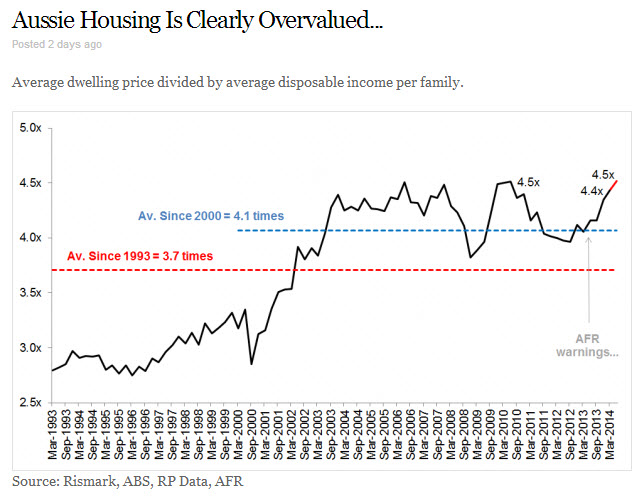
And well might the RBA be concerned. The graph below that has appeared in a few places in the last week shows that Australian housing affordability is currently at its all-time worst, and getting worse. At 4.5 times family disposable income, we are now in an era where two incomes are mandatory to afford a house.

housing affordabilityNot only is this an economic and financial issue, it is very directly a social issue. It creates things like the intense pressure on child day care; pressure on rental housing and social housing.

Governments everywhere are stuck, and out of ideas.  The problems materialize in different ways in different countries, but there is a theme, housing the population in an acceptable affordable manner requires big tough policy choices. And, not many politicians are up to the job.

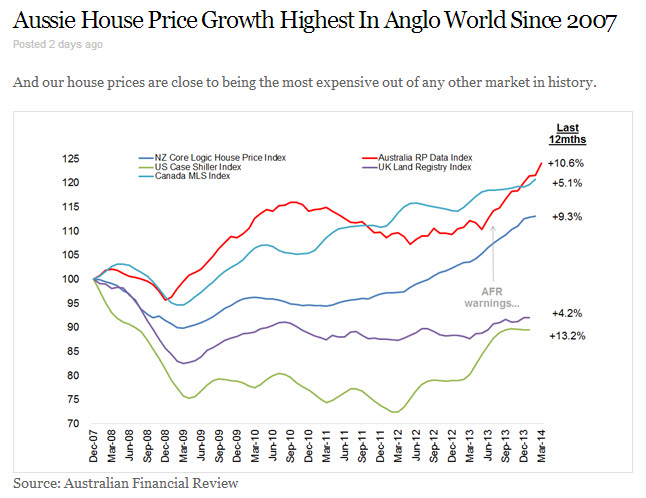
five countries house prices

Here’s another perspective on house prices. This graph above is a comparison of the movement in house prices since 2007 in the “anglo world”. Australia (red line) and Canada (light blue line) have shot ahead. (Like Australia, Canada has a huge resources sector.) New Zealand has too, and they are now acting directly to try to cool things down. The UK (purple) and the US (green) are still down from 2007.

Whilst many are reluctant to call Australian house prices a bubble, there is no doubt they are precariously high, riding on huge credit facilities from the big four banks. So, as the real economy continues to weaken, soft incomes will simply force prices to down.

So I’m “looking out below” … When will the turning come? … Anyone’s guess, but pretty soon, I reckon.

Posted in debt, risk | Tagged , | Leave a comment