
“There are decades where nothing happens; and there are weeks where decades happen.” … Vladimir Lenin
It feels like we might be in one of those “weeks” …
From this distance the Middle East looks unbelievably complex. Scant few can hope to understand fully what’s going on right now. Fewer still can predict where current events will turn.
But we can be sure of just a few big things, I think.
Tribal, ethnic and religious rivalries always run deep. Think: the Crusades; the seemingly endless European Holy Wars of the 16th and 17th century; the deadly, decades long Troubles in Ireland that can be related back to 1533 when Henry VIII broke from the Catholic Church; the Holocaust; the Rwanda genocide; the breakup of Yugoslavia along historic ethnic lines in the 1990’s; and so many more deadly conflicts.
The differences between Sunni and Shi’ite go all the way back to the year 632. Two relatives of Mohammed had different views about who was who and what was what after the great prophet’s death.
So as a result, we have two main branches of Islam. Evidently, many on each side of this historic divide don’t like each other, despite having 1382 years to try to sort out their differences.
Now this rivalry is exploding in Northern Iraq.
This is also the part of the world where the cheapest oil comes from. Western economic interests will be deeply affected (as they were in the 1970’s) if things go bad.
Access to oil is why the British and French Empires threw their weight around in the first half of last century. They did things like draw a line on a map and said to those on the left (west) you are Syrians and those on the right (east) you are Iraqis. Imperial schoolmaster stuff! It paid little heed to the interests of the people affected.
Then after the second world war the American imperialists took over and started to push everyone around … all in the name of looking after their own “interests”. (Oil.)
So, for instance, in 1953 the CIA organised a coup in Iran to install the Shah who would be more friendly to America. But in 1979 the tables turned. Iranians revolted. A fundamentalist Shi’ite regime took over. Not to be outdone, the Americans then backed the Sunni leader of neighbouring Iraq, Saddam Hussein, in one of the deadliest, long, border wars between two nations: 1980 to 1988. That 8 years cost maybe a million lives, but resolved nothing.
Long before 1995 Saddam had turned, and became an enemy of the USA. But then he had the audacity to invade Kuwait. Definitely not in American “interests”. (Oil.) So ensued Desert Storm, the first Iraq war. Iraq was smashed, but Saddam left to fight another day.
Then came 9/11. Perpetrated by a group dominated by Saudi Arabian citizens, this event shocked America and immediately they were looking for someone to smack. By January 2002 both Iran and Iraq were members of George Bush’s “axis of evil”. Curiously, vastly oil rich Saudi Arabia has never come under the same cloud, or even suspicion. American “interests” (oil), again?
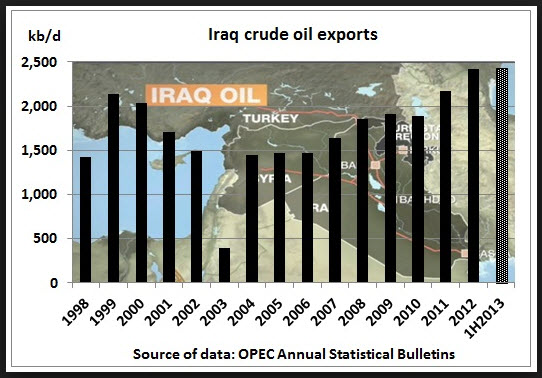
In 2003 the US and “the coalition of the willing” invaded Iraq. Weapons of mass destruction. Harbouring terrorists. Evil dictatorship. These were the war cries. Again the fabric of the country was smashed. The war (against exactly whom became a shifting and dubious target) dragged on and on. Not much was achieved. Except of course, that after the initial “shock and awe” the production and flow of oil from Iraq was put onto a nice secure footing for western interests:
But the fundamental objective for this war was regime change: the meddling world improvers, Cheney and Rumsfeld (and Bush) thought it was time to bring democracy to the arab Middle East. But …
Democracy requires the consent of ALL the governed. Democracy works (well sort of) in countries like the USA and Australia, because we argue, we pitch, we spin, and then, relying on what we learn from putative politicians, associates and the free media, we vote. Then, when the votes are in and the choice is made, we accept the majority position. Not always happily mind you, but accept it we do. Until next round.
In countries where boundaries are “artificial”, where there are communities with long histories of rivalry or conflict forced together, this principle of consent to be governed, so fundamental to a working democracy, just doesn’t work. The Americans seem to have missed that point in the Middle East. No amount of bullying, voting, or anything else will change this. The whole of the citizenry must want it.
So the do gooders and world improvers were doomed to fail in their objective after 2003, and they are doomed to fail now in 2014. Calls for Iraqi “political leaders to unite” against the ISIS terror threat are unrealistic and hollow. Nothing the US can now do in Iraq – that fractious mix of Sunnis, Shi’ites and Kurds (and other minorities) – will turn it into a peaceful, safe, working democracy any time soon, perhaps ever.
A break up (like Yugoslavia) looks a likely outcome. Who knows where that would lead on the issue of oil supply security to the west.


 something 2 ponder