
Whilst we’re all distracted by the extraordinary events in Ukraine and Crimea, and the hunt for MH370, things in China are looking dodgier by the day.
In the last 5 years the Chinese have created $16 trillion in credit. That is just an incomprehensible amount of debt. For perspective, the US Fed has created less than $4 trillion (in a much bigger economy and market) in the same period.
In China, this debt has been used to finance manufacturing capacity, housing, all types of infrastructure, even whole cities, all way beyond requirements. You’ve seen and heard the abundant stories. Surplus, uneconomic “assets” are everywhere.
At the right scale, building economic assets a little ahead of requirements and financing them with debt is OK. As the economy then grows the surplus is absorbed and new cash flows repay the debt. The problem in China is that this has gone way too far. In a world where growth rates are falling, the surplus “assets” are too numerous and the future cash flows insufficient. It’s a train crash waiting to happen.
In addition, whilst doing this, China has plundered and polluted its natural resources and environment on an unprecedented scale. Rectification, where that is possible, will be at gigantic extra cost to the economy and take decades. Even then the restoration will be only partial. But that’s a story for another day …
Debt binges like this are hardly unprecedented. The US sub-prime debt bubble is the biggest most recent one and we all know how well that ended. But, closer to the China story is Japan in the period up to 1989, and even South Korea leading into 1998.
In these two economies, with a steady diet of cheap money and aided by connections to Government, enterprises kept adding capacity at home and abroad with little regard to profitability or return on capital. They simply focused on producing more stuff and expanding their size. Jobs were created. The good times rolled … until they didn’t.
Eventually they collapsed under the load of unsustainable debt. Markets crashed. Japan’s economic growth, equity markets, and real estate values have never recovered. Not even close.
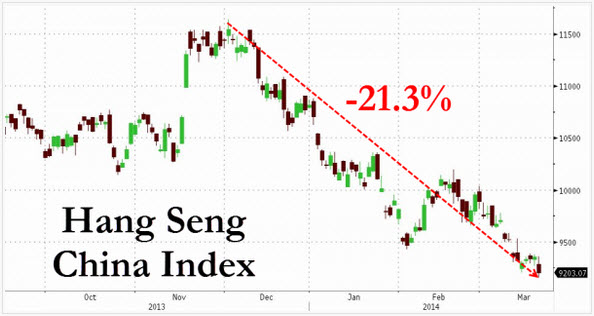
In the command and control economy that is China, the government has a problem (actually, lots of them). Markets are on edge and moving ominously. Here’s the reaction in the Hong Kong stock market since December to the value of Chinese companies:
Here’s the UK Daily Telegraph this week:
“China’s yuan has suffered its biggest one-week fall in 20 years, nearing key trigger levels that threaten a wave of forced selling and mounting stress for those with dollar debts.
The jitters come amid reports of fire-sales of Hong Kong property by Chinese investors desperate to raise cash, some slashing their prices by 20pc for a quick sale. A liquidity squeeze in mainland China has already led to the collapse of Zhejiang Xingrun real estate this week with $570m of debts, the biggest property failure so far.”
And here’s a piece from Zerohedge:
According to The [Hong Kong] Standard, “Highsee Group’s 3 billion yuan debt was overdue last week,” the 21st Century Business Herald reported yesterday. “The company is running in red, and has failed to pay workers for months. Many of its furnaces have stopped operating.”
The reason for this most recent collapse: the plunge of domestic steel prices, which have fallen to their lowest level in more than eight years in mid-March as a result of weak demand and a surge in output.
Meanwhile iron ore stockpiles are at record highs and prices are falling. Copper, that metal that goes into just about everything (housing, cars, appliances, electronics, motors) shows significant price weakness.
Can the Government and the Central Bank hold this together? Logic and history says no. and Morgan Stanley now has doubts:
“… China is approaching a “Minsky Moment”, a turning point when credit bubbles implode under their weight. “There is evidence that this debt growth has become excessive and non-productive. It now takes four renminbi [yuan] of debt to create one renminbi of GDP growth from a nearly 1:1 ratio in the early and mid-2000s.”
“It is clear to us that speculative and Ponzi finance dominate China’s economy at this stage. The question is when and how the system’s current instability resolves itself,”
And the size of this bubble is unprecedented.
Moreover a big collapse in China will ripple around the already fragile economic world in a relative heartbeat, potentially dwarfing the roll-on economic effects of Japan in 1989 or Wall Street in 2008. (Both of which continue today.)
As Sovereign Man blog put it this week:
“This is the first time in China’s modern history they’ve had a default, let alone two. They can no longer keep the game up, and the dominoes are beginning to topple.”
A daunting prospect indeed … but nobody knows: that’s what’s so interesting about the future!


 something 2 ponder
Crikey Geoffrey, have you pondered the ramifications?
4th, 5th and 6th Speed Economy… how many gears are left?