
Governments, corporations and people borrow to pay for something they need now, but don’t have enough cash/savings to pay for now.
If that something is a hard economic asset (say, a power station, or a house), part of the future income flowing from operating/using the asset (sales of electricity, rent) repays the loan and pays interest over the useful life of the asset.
Bankers borrow from those with surplus cash/savings, and make their money by lending carefully to borrowers (like those above) who can repay from the future cash flow generated over time by their underlying asset.
Quite simple, really.
A debt model like this is usually perfectly OK. Bankers have been making loans like this for centuries.
Now it’s all gone pear shaped because of greed. For a century or more, gradually at first, but now at an exponential rate, the fundamentals of the debt model above have broken.
Bankers were driven to try to make more for themselves by lending more.
First, they figured they could lend out more money than they had: they could create money out of thin air! And so we have fractional reserve lending. This relies on the bet that depositors won’t want their money back faster than the borrowers were repaying. That works, until it doesn’t.
Down the years, it’s a bet by bankers that has gone very bad thousands of times. Yep, thousands. Here’s just one:
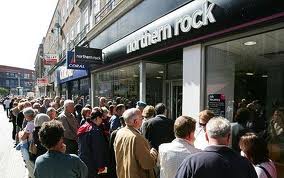
Of course, they weren’t queuing to put money in … Ugly, eh.
In 2008 there were many banks faced with this predicament, but Governments stepped in with money and guarantees to avoid the otherwise inevitable calamity. Some we know about. Many more, I suspect, are still a secret. (We just don’t know how vulnerable even the biggest of the Australian banks was absent the Government’s guarantee.)
Second, bankers started risking the relaxation of the sensible lending principles above.
Bankers lent for consumption. Credit cards were handed out without a care. There was no asset, no future cash flow directly relating to the loan. This was just borrowing from the future, period.
Bankers lent for real assets borrowers wanted (rather than needed) like empty Chinese cities? And to borrowers who didn’t have any (rather than enough) cash/savings money and no income themselves (US sub prime).
Then the requirement for hard economic assets was by-passed. Future income was mortgaged: (Student loans in the US are $1+ trillion). Financial assets were leveraged: (Margin lending on Wall Street passed it’s all time high late last year).
All that is bad enough, but …
… then, when all else failed, greedy bankers made up weird “products” out of nothing, then lent against them. And then, just to be sure they didn’t lose money, bet against them. (This derivatives “market”/house of cards/casino is around $700 trillion!)
The 2014 financial market’s detachment from economic reality is truly breathtaking.
The bad debt is problem enough. Worse, is that all this unreal debt dwarfs the good debt, the banks equity, and the depositors’ funds. And if when, as happened in 2008, the music stops, the collapse will be spectacular.
Governments used all their dry powder in 2008. Next time will be different!


 something 2 ponder